Future-Proof Your Marketing Strategy Effectively
Marketing Strategy, Future-proofing, Digital Marketing
How to Future-Proof Your Marketing Angle (From a Business Owner’s Perspective)
As a business owner, you’ve probably felt it:
One month your marketing is working, the next month your reach drops.
Ads suddenly cost more for the same results.
Everyone is talking about a new AI tool or social platform you “have” to use.
It can feel like the rules change overnight. The truth is, if your marketing message depends too much on any one platform, tactic, or trend, it’s fragile. Let’s walk through how to build a marketing approach that still works even when algorithms, tools, and trends keep shifting.

Future-Proof Your Marketing Angle
Build campaigns that survive AI and algorithm shifts
Future-Proofing: Think Like a Business Owner, Not a Trend Chaser
Future-proofing your marketing simply means this: you’re not starting from scratch every time the online world changes.
Instead of building your message around a single platform (“we’re huge on TikTok” or “we crush it with Facebook ads”),
Build it around a clear, simple promise that matters to your customers (“we help busy teams grow revenue without burning out their staff”).
Social media apps, ad tools, and AI features will keep changing. But your customers’ real problems and motivations stay fairly consistent:
Saving time
Making more money
Reducing stress
Getting better results
That’s what your core marketing angle should focus on.
Your core angle should answer three questions in plain language:
Who are you helping? Be specific, e.g., “local service businesses,” “B2B founders,” or “small e‑commerce brands under $5M/year.”
What painful problem do you remove? Say it the way your customers would: “I’m tired of…” or “I just want…”
Why are you different in a way that matters? For example: faster turnaround, better support, more transparent pricing, or a proven process.
💡 Friendly Business Tip: Pretend you’re explaining your offer to a friend over coffee. If you can’t say what you do, who it’s for, and why it’s different in under 30 seconds, your marketing angle is probably too complicated.
Building a Resilient Marketing Strategy in a Digital World
A strong, resilient marketing strategy mixes timeless basics with room to test new ideas. Think of it like your business itself:
You have a core offer that rarely changes.
You can adjust pricing, packaging, or how you talk about it as you learn more.
Core story: This is the big picture of who you are and why your business exists. For example: “We help small teams market like big brands without big budgets.”
Supporting messages: These are different angles for different groups. One for new customers, one for repeat buyers, one for partners, etc. Same story, just told in slightly different ways.
Channel versions: This is how that message shows up in email, on your website, in social posts, in ads, or in person. The words might change a bit, but the promise stays the same.
When you treat your marketing this way, you can:
Try new platforms without reinventing yourself.
Pause old ones without losing momentum.
Adjust campaigns without losing your identity. Your customers still recognize you, no matter where they find you.
Navigating AI Advancements Without Losing Your Voice
AI is everywhere now: tools that write posts, design images, plan ad campaigns, and more. Used well, AI can save you a lot of time and money. Used poorly, it makes your brand sound like everyone else and confuses your audience.
The goal is to treat AI like a smart assistant, not like your head of marketing. Here are simple, practical ways to use it:
Ask it for headline ideas based on your existing message, then pick and tweak the ones that sound most like you.
Have it shorten long content (like a blog or email) into a few social posts that still reflect your main angle.
Use it to spot patterns in what people click, open, or respond to most, so you know which topics your audience cares about.
But your stories, examples, and opinions should still come from you and your team. That real-world experience—how you’ve helped customers, lessons you’ve learned, mistakes you’ve fixed—is what makes your marketing feel human and trustworthy. That’s the part AI can’t truly copy, and that’s what keeps your marketing strong over time.
Handling Algorithm Changes Without Panicking
Search engines, social media platforms, and ad networks are always changing how they decide what to show people. One update can make your reach jump or drop overnight. If your whole growth plan is “rank #1 for this one phrase” or “go viral on this one app,” you’re taking a big risk.
Instead, think of algorithms like the weather. You can’t control them, but you can:
Watch your key numbers regularly (visits, leads, sales) so you notice big changes early.
Avoid relying on just one channel. Mix search, email, social, referrals, and partnerships where it makes sense for your business.
Give changes a little time before you react. Not every bad day is a crisis; look for patterns over at least a couple of weeks.
Below is a simple example from a developer’s world that checks for big drops or spikes in website visits. You don’t need to run this code yourself—the point is the mindset: have a simple way to notice when something is way off, then calmly investigate.
import statistics
from datetime import datetime, timedelta

def get_daily_sessions(days: int) -> list[int]:
    # Replace this with your real analytics API call
    # For example, Google Analytics, Plausible, or internal dashboards
    return [120, 130, 125, 118, 400, 115, 119][:days]

def detect_anomaly(window: int = 5, threshold: float = 2.0) -> bool:
    data = get_daily_sessions(window + 1)
    baseline = data[:-1]
    latest = data[-1]

    mean = statistics.mean(baseline)
    stdev = statistics.pstdev(baseline) or 1
    z_score = (latest - mean) / stdev

    print(f"Baseline mean={mean:.2f}, stdev={stdev:.2f}, latest={latest}, z={z_score:.2f}")
    return abs(z_score) >= threshold

if __name__ == "__main__":
    if detect_anomaly():
        print("🚨 Possible algorithm change or tracking issue detected. Investigate!")
    else:
        print("✅ Traffic within expected range.")
You don’t need a full data team to benefit from this way of thinking. Even basic tracking—checking your numbers weekly and flagging anything that looks extreme—helps you respond to changes calmly instead of reacting out of fear.
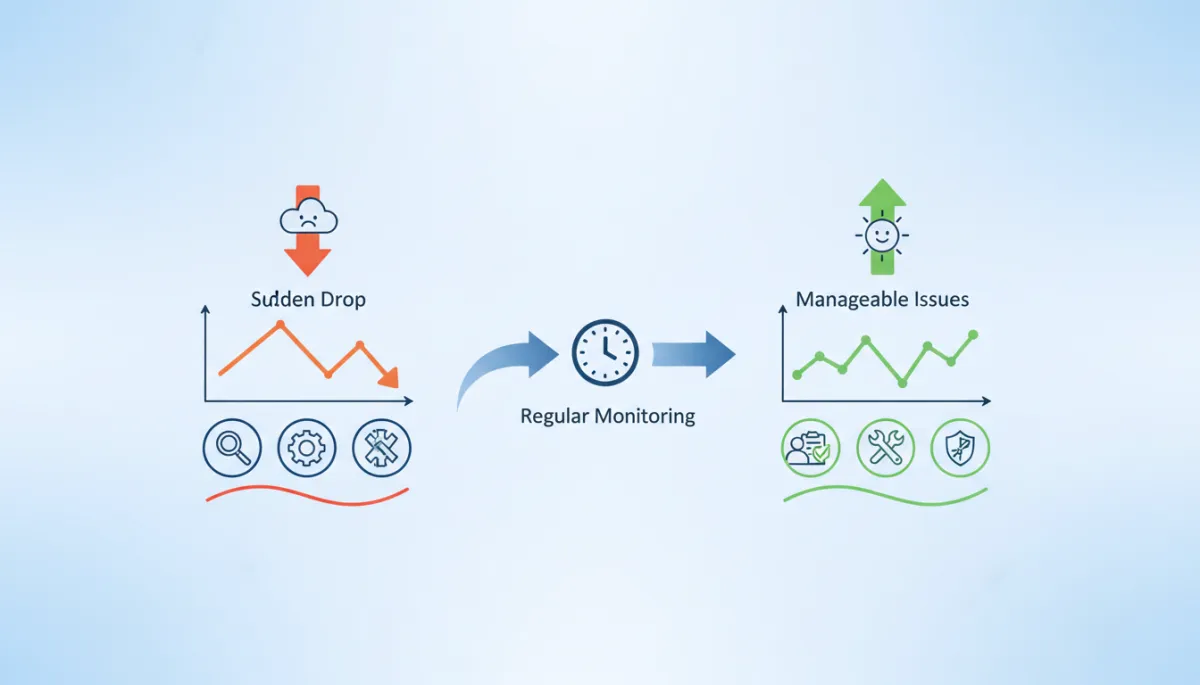
Lightweight monitoring turns scary traffic drops into manageable debugging sessions.
Content Optimization: Treat Your Content Like a Business Asset
Future-proof marketing isn’t about posting nonstop. It’s about making what you already have work harder for you. Just like you might improve a product, a service, or a process over time, you can improve your content instead of always creating from scratch.
A simple habit that pays off: keep a short list (even in a spreadsheet) of your key content—important blog posts, landing pages, lead magnets, or videos—with notes like:
What the topic is and who it’s for
Which keyword or question it’s trying to answer
How it’s performing (roughly: doing well, flat, or dropping)
When you last updated it
Below is a small example from a technical workflow that helps pick which pages to refresh. You don’t have to use code like this—but the idea is useful: decide ahead of time which content you’ll revisit regularly, instead of only “fixing” things when they’re obviously broken.
import json
from datetime import datetime

def load_content_inventory(path: str) -> list[dict]:
    with open(path, "r", encoding="utf-8") as f:
        return json.load(f)

def find_candidates_for_refresh(pages: list[dict], max_age_days: int = 180) -> list[dict]:
    today = datetime.utcnow().date()
    candidates = []

    for page in pages:
        last_updated = datetime.fromisoformat(page["last_updated"]).date()
        age = (today - last_updated).days

        if age > max_age_days and page["traffic_trend"] in ("flat", "down"):
            candidates.append(page)

    return candidates

if __name__ == "__main__":
    pages = load_content_inventory("content_inventory.json")
    to_refresh = find_candidates_for_refresh(pages)

    print("Pages to optimize:")
    for page in to_refresh:
        print(f"- {page['url']} (topic={page['topic']}, age>180d)")
Whether you use tools, spreadsheets, or just a simple list, the principle is the same: treat your content like an asset you maintain, not a one‑time task you forget about. That mindset alone will keep your marketing fresher and more effective over the long run.
Using Data Without Becoming a Slave to Metrics
It’s easy to get obsessed with every little change in your numbers:
One bad day of sales
A dip in website visits
A lower open rate on one email
But if you react to every bump, you’ll constantly change direction and confuse both your team and your audience.
Future-proof marketing uses data to check if you’re on the right track, not to rewrite your entire strategy every week. A healthy balance looks like this:
Use metrics to see which channels (email, social, search, referrals) carry your main message best, then lean into those.
Test different headlines, offers, or layouts, but keep your core promise—the main reason people buy from you—the same.
Review performance in meaningful timeframes (monthly or quarterly), not hour by hour. That’s how you spot real trends, not random noise.
📌 Key Takeaway: Think of your analytics like regular checkups for your business. They tell you if things still look healthy, but they don’t decide who you are or what you stand for.
Pulling It All Together: A Future-Proof Marketing Checklist for Business Owners
Whether you’re a founder, a small business owner, or leading a lean team, here’s a straightforward checklist to keep your marketing angle strong, even as AI and algorithms keep changing:
Clarify your core value story in one or two sentences that don’t mention specific platforms or trends—only the problem you solve and the result you deliver.
Write down a few message variations for different types of customers (new vs. existing, small vs. large, etc.) so your team knows how to talk to each group.
Use AI tools on purpose for ideas, drafts, and summaries—but always add your own stories, examples, and tone before anything goes live.
Watch a few key numbers (like leads, sales, or booked calls) and set simple “alerts” for yourself when something changes a lot, instead of staring at dashboards all day.
Keep a basic content list and plan regular “refresh sessions” to update and improve your most important pages, emails, or offers a few times a year.
Review your strategy regularly (quarterly is enough) to make sure your marketing still matches your actual business, your customers, and your goals.
Final Thoughts: Treat Marketing Like a Living Part of Your Business
Future-proofing your marketing isn’t about guessing the next big social platform or memorizing every update from Google. It’s about building your message on a solid foundation: who you serve, what you help them achieve, and why they should trust you. Once that’s clear, tools, trends, and tactics become easier decisions—not constant emergencies.
If you treat your marketing like a living part of your business—something you test, monitor, and improve over time—you’ll be far better prepared for whatever comes next. AI will get smarter, algorithms will keep shifting, but your clarity about your customers and your value will keep you grounded. And that kind of stability is exactly what busy business owners need in a noisy, fast-changing digital world.
Conclusion: Take the Next Step to Future-Proof Your Marketing
You now have a practical framework to keep your marketing steady, even when platforms, tools, and trends keep shifting. To recap, a future-proof marketing angle:
Starts with a clear, customer-focused value story—not a specific channel.
Uses AI and data as helpers, not as the decision-makers of your brand.
Treats content as an asset you maintain and improve over time.
Relies on simple, steady monitoring instead of constant panic over metrics.
📌 Your Next Move: Choose one area—your core value story, your content list, or your basic metrics—and improve it this week. Small, consistent upgrades beat big, one-time overhauls.
If you’d like support clarifying your angle or turning this into a concrete plan for your business, we’re here to help. Let’s talk. Email us at [email protected].


