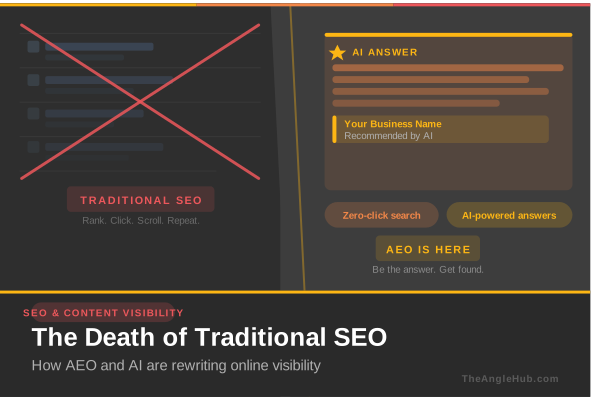
AEO & AI: The New Era of Online Visibility
Digital Marketing, AEO, Small Business Growth
The Death of Traditional SEO: How AEO and AI Are Rewriting Online Visibility
“The future of visibility belongs to those who become the clearest answer.” — By Shannon Torres
If you’re a coach, consultant, or small business owner still hanging your hopes on old-school SEO tricks, it’s time for a reality check. Search is changing fast, and the new game isn’t about ranking #1 on Google—it’s about becoming the answer inside AI tools like ChatGPT and Google’s AI Overviews.
1. The Death of Traditional SEO (at Least as You Know It)
For years, SEO felt like gaming a system: cram in the right keywords, write a few blog posts, chase backlinks, and hope you climb the rankings. That world is disappearing. Not overnight—but fast enough that ignoring it is risky for any small business.
Think of traditional SEO like trying to get your flyer on the top of a big stack at the local coffee shop. If your flyer is on top, people see you. If not, you’re invisible. But now, many customers don’t even walk into the “coffee shop” (Google results page) anymore. They ask an AI tool, get one clear answer, and move on—no scrolling, no clicking ten blue links. Researchers call this a “zero-click world,” where the answer lives on the search page or inside an AI chat, not on your website (innovationopenlab.com).
By 2026, Google’s AI Overviews are already showing alongside about a quarter of searches, and AI referral traffic—people coming from AI tools—is growing steadily, led largely by ChatGPT (innovationopenlab.com). So the question is no longer “How do I rank?” but “How do I show up in those answers?”
💡 Simple takeaway: Traditional SEO isn’t dead, but it’s no longer the main character. It’s now just one part of a much bigger visibility puzzle.
2. Meet AEO: Answer Engine Optimization in Plain English
AEO—Answer Engine Optimization—sounds technical, but the idea is simple: instead of just trying to rank in search results, you’re trying to be the business that AI tools quote, mention, or recommend when someone asks a question.
Imagine you’re at a networking event. One person stands in the corner handing out business cards (that’s traditional SEO). Another person is being recommended over and over: “Oh, you need a leadership coach? Talk to Sarah. Need a local physiotherapist? Go see Mark.” That second person is doing AEO. They’re baked into the conversations, not just visible on the table of flyers.
In practical terms, AEO means:
Writing content that directly answers real questions your clients ask, in clear language—no fluff, no jargon.
Structuring information so machines can understand it: clear headings, FAQs, and up-to-date details like prices, locations, and services.
Building trust signals—testimonials, case studies, real credentials—because AI systems heavily favor sources that look reliable and consistent (norisk.group).
Big brands are already treating AEO as core infrastructure, not just a marketing side project. They’re tracking new metrics like “citation rate” and “answer share”—how often they’re mentioned inside AI answers—rather than just website visits (innovationopenlab.com). Small businesses can borrow the same mindset on a lighter scale.
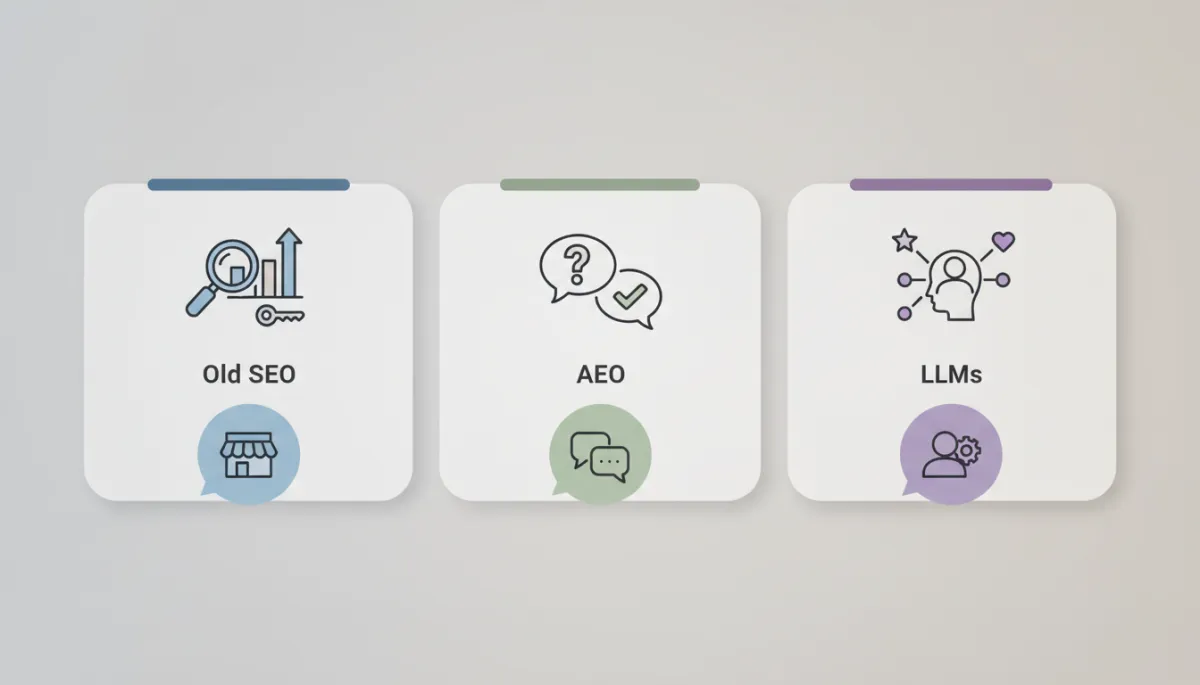
Visibility is shifting from blue links to being named inside AI-generated answers.
3. How LLMs Are Changing the Way People Find Your Business
LLMs—Large Language Models—are the brains behind tools like ChatGPT, Perplexity, and many AI chatbots. They read huge amounts of text and then generate conversational answers. For your business, the key shift is this: people increasingly ask AI first, and only visit websites second—if at all.
Instead of typing “best business coach near me” and scrolling, a user might ask: “I’m a burned-out founder in my 40s. Recommend a coach who specializes in leadership and work–life balance in Toronto.” The AI doesn’t just match keywords; it understands context—age, role, pain point, and location. Then it pulls from sources it trusts and gives a short list of answers, sometimes with direct business names and links (searchenginejournal.com).
LLMs are also powering:
Voice search (“Hey Siri, find me a local nutrition coach who works online”)—which means content needs to sound like natural conversation, not robot-speak.
Personalized answers based on past behavior, profession, or location (stackmatix.com). Two people can ask the same question and see different suggestions.
Content recommendations—articles, videos, and resources surfaced because they match a user’s situation, not just a keyword (moz.com).
Analogy that sticks: Think of LLMs as smart concierges. Your goal is to be the go-to business they recommend when someone describes their problem.
4. What Small Businesses and Coaches Should Do Now
You don’t need a massive budget to adapt. You do need to be intentional. Here’s a simple, AEO-friendly action plan:
Turn your FAQs into real answers. Take the 10–20 questions clients ask you most and create clear, stand-alone answers on your website and social channels. Use headings like “Question” and “Answer” so both humans and machines can follow.
Write for conversations, not just keywords. Use everyday language. Include the context people mention: “busy parents,” “remote teams,” “post-injury rehab,” and so on. LLMs are built to understand natural language, not keyword stuffing.
Keep your details fresh and consistent. Make sure your business name, location, services, and pricing ranges are accurate across your website, Google Business Profile, and major directories. AI systems reward up-to-date, consistent data (norisk.group).
Show proof of trust. Highlight testimonials, case studies, certifications, and media mentions. These are the human signals that feed into the “trust” judgments AI tools increasingly make (often described as E‑A‑T: Expertise, Authority, Trustworthiness).
Experiment with AI yourself. Ask ChatGPT or Perplexity: “Who are the best [your niche] in [your city]?” See who shows up and what’s said. That’s your new competitive landscape.
Final Word: Don’t Chase Algorithms—Become the Best Answer
Traditional SEO was about pleasing a search engine. AEO and the rise of LLMs are about something more human: clearly solving real problems, in real language, with enough proof that both people and machines trust you. As AI-powered search keeps growing and could overtake traditional search traffic in the next few years (stackmatix.com), the businesses that win won’t be the ones who gamed the system. They’ll be the ones who consistently show up as the best, clearest, most trustworthy answer.
For a coach, consultant, or small business owner, that’s good news. You don’t need to out-hack the internet. You just need to deeply understand your clients, speak their language, and structure your online presence so that today’s “answer engines” can confidently point people your way.
Conclusion
If you’re ready to move beyond chasing algorithms and start positioning your brand as the go-to answer inside AI tools, now is the time to act. Align your content, clarify your offers, and make it effortless for both humans and machines to trust and recommend you.
Let’s talk. Email us at [email protected] and we’ll help you turn your expertise into AI-ready visibility.


