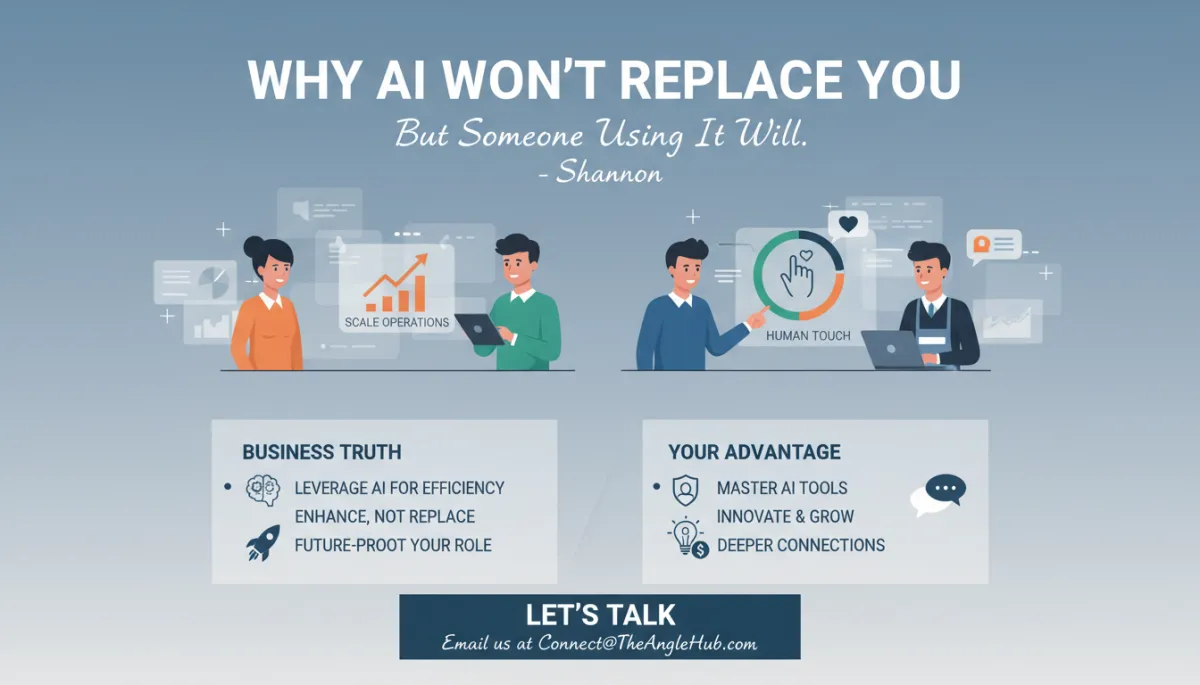
Embrace AI: Enhance Your Work, Not Replace It
AI, Future of Work, Productivity, Human-Centered Business
Why AI Won’t Replace You (But Someone Using It Will)
“AI isn’t here to erase your value. It’s here to expose it—if you’re willing to use it.”
— Shannon
Artificial intelligence is everywhere—on your phone, in your inbox, behind the websites you visit and the tools you use at work. That visibility has sparked a very human fear: “Will AI replace me?” The more accurate question is, “Will I be replaced by someone who knows how to use AI better than I do?”
The Truth About AI in Business: What It Really Does (And Doesn’t) Do
There’s a lot of hype and a lot of panic around AI. To make smart decisions—for your career or your business—you need a clear, grounded view of what AI actually does in practice.
📌 Quick Reality Check Infographic: Imagine a simple chart with two columns—“What AI Is Great At” vs. “What Humans Are Irreplaceable For.” Most of your unique value sits in the human column.
What AI Is Actually Good At
Repetitive tasks: Data entry, formatting, summarizing, basic reporting, document drafting.
Pattern recognition: Spotting trends in sales data, customer behavior, or website traffic faster than a human ever could.
24/7 responsiveness: Handling simple customer questions at any hour without breaks or burnout.
Drafting and ideation: Generating first drafts of emails, social posts, product descriptions, or internal docs.
What AI Cannot Replace
Trust and relationships: People buy from people they trust, not from algorithms. AI can assist, but it can’t authentically care.
Context and nuance: Understanding office politics, culture, tone, and timing is still deeply human work.
Ethical judgment: Just because AI suggests something doesn’t mean it’s right, kind, or aligned with your values.
Original vision and leadership: AI can remix the past; humans imagine the future.
💡 Pro Tip: Don’t ask, “Will AI take my job?” Ask, “Which 30–50% of my tasks could AI handle so I can focus on higher-value work?”
Why Someone Using AI Is More Dangerous to Your Job Than AI Itself
The real competitive advantage isn’t AI alone—it’s humans who know how to partner with AI. Those people:
Get more done in less time, without working longer hours.
Deliver faster responses to customers and colleagues.
Make better decisions because they’re informed by data, not just gut feelings.
Free up time to build relationships, strategize, and innovate.
If you ignore AI, you’re not competing against a robot—you’re competing against another human who has turned AI into their personal assistant, analyst, and creative partner. That’s the person who can outpace you in the same 8-hour day.
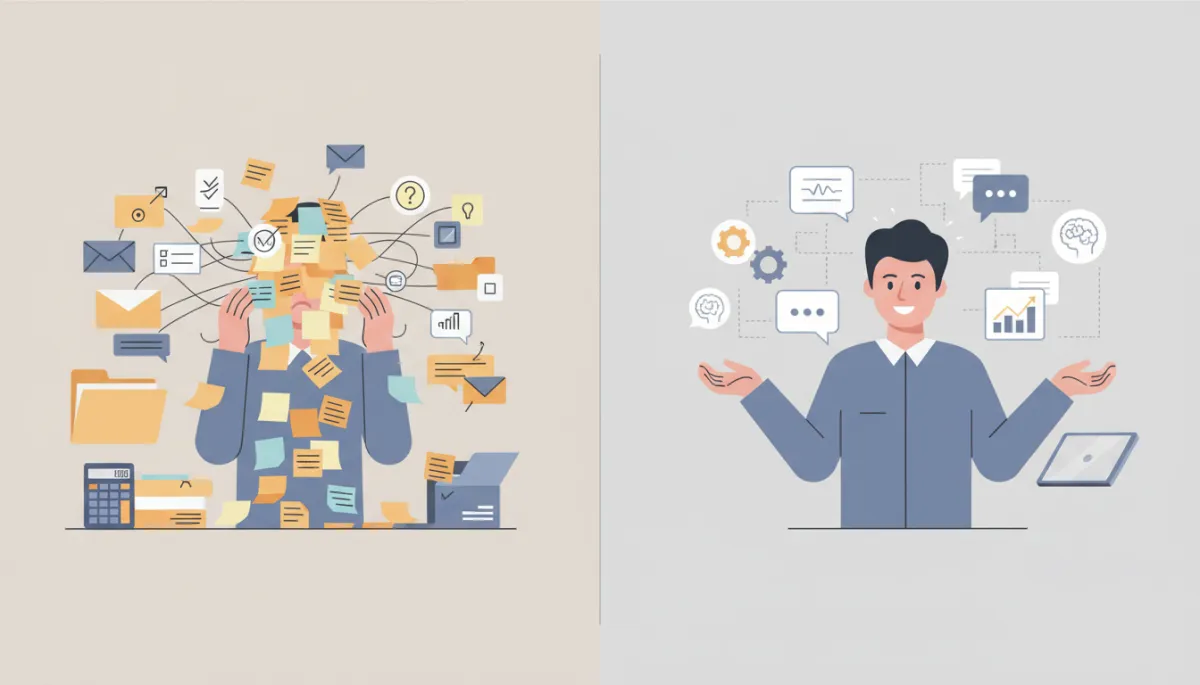
-color flat infographic comparing two workers side by side, one overwhelmed with sticky notes...
The same role can look stressful or strategic depending on how you use AI.
How to Leverage AI to Scale Operations Without Losing the Human Touch
Step 1: Audit Your Tasks—Where Can AI Help?
Whether you’re an employee, freelancer, or business owner, start by mapping your typical week. Then mark tasks that are:
Repetitive (you do them the same way every time)
Time-consuming (but don’t require deep expertise)
Data-heavy (reports, analysis, research, summaries)
These are prime candidates for AI support. Think of AI as your first draft generator and pattern spotter, not your replacement.
Step 2: Keep Humans in the Moments That Matter
Scaling with AI doesn’t mean automating every interaction. It means being intentional about where you stay fully human. For example:
Use AI to draft customer emails—but personally review and tweak anything sensitive or high-value.
Let chatbots answer FAQs—then route complex or emotional issues to a real person who can listen and empathize.
Use AI to summarize meeting notes—but you decide the priorities and next steps.
📌 Human-First Rule: Automate the process, not the relationship. If a moment requires empathy, nuance, or trust-building, keep a human in the loop.
Step 3: Use AI to Amplify Your Strengths, Not Hide Your Weaknesses
The people who thrive with AI know themselves well. They use AI to push their strengths further, not to pretend to be someone they’re not. For example:
If you’re great with people but hate admin, let AI handle scheduling, reminders, and note-taking so you can spend more time in conversation.
If you’re a visionary founder, use AI to turn your rough ideas into structured plans, pitch decks, or SOPs your team can follow.
If you’re detail-oriented, use AI to surface patterns and anomalies you can then investigate more deeply.
Step 4: Build Simple, Human-Centered AI Workflows
You don’t need a full-time data science team to benefit from AI. Start with small, practical workflows like:
Customer support: AI drafts responses; humans approve and personalize before sending.
Marketing: AI generates content ideas and outlines; your team injects brand voice and stories.
Operations: AI summarizes reports and dashboards; leaders decide what actions to take.
💡 Pro Tip: Document your AI workflows. Treat them like any other process so your team knows when and how to use AI—and when to step in as humans.
Your New Competitive Edge: Human + AI, Not Human vs. AI
The future of work isn’t a battle between humans and machines. It’s a partnership. The people and businesses who win will be those who:
Understand what makes them uniquely human and double down on it.
Use AI to handle the busywork so they can focus on strategy, relationships, and creativity.
Stay curious, keep learning, and treat AI as a skill, not a threat.
Conclusion: Don’t Compete With AI—Lead With It
AI won’t replace your empathy, your judgment, your lived experience, or your ability to connect with another human being. But someone who understands how to use AI to free up their time, sharpen their decisions, and scale their impact can absolutely outpace someone who doesn’t.
Whether you’re an individual looking to future-proof your career or a business leader wanting to scale without losing your soul, the path forward is the same:
Get honest about what AI can and can’t do in your world.
Start small with practical, human-centered workflows that save time and energy.
Reinvest that saved capacity into relationships, strategy, and meaningful work.
📌 Key Takeaway: AI is not your replacement; it’s your leverage. The question is whether you’ll pick it up.
If you’re ready to explore how AI can help you or your business scale without losing the human touch, let’s talk about what that looks like for you specifically—your team, your customers, your goals.
Let’s talk. Email us at [email protected] and we’ll help you design AI-powered workflows that keep people at the center—where they belong.


